
How to Scope Software So It Actually Ships
Most projects don't fail in the code — they fail in the scope. Here's the boring discipline of defining what you're building so it lands on time and does the job.
By Ali Kolachi
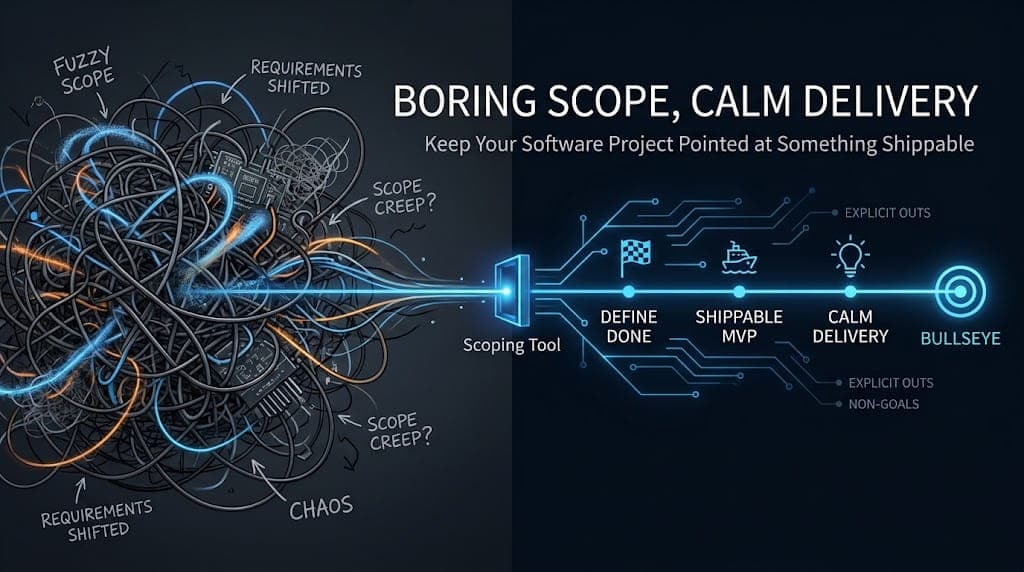
Ask why a software project went sideways and you'll rarely hear "the code was too hard." You'll hear that it grew, that requirements shifted, that "while we were in there" turned a two-week job into a two-month one. Projects don't usually die of technical difficulty. They die of fuzzy scope.
Good scoping is unglamorous and it's most of the game. Here's how we keep a project pointed at something shippable.
Define done before you define how
The first artifact of a healthy project isn't a plan — it's a sentence everyone agrees on: when this works, a user can do X, and we'll know because Y. If you can't write that sentence, you're not ready to estimate, let alone build.
The trap is jumping straight to solutions. "We need a dashboard" is a solution. "A manager needs to see which orders are stuck, in under five seconds, without asking support" is an outcome — and it's specific enough to build against and test against.
If two people on the team would describe "done" differently, you don't have a scope. You have a disagreement you haven't had yet.
Cut to the smallest version that's still useful
Every project has a version that delivers 80% of the value for 30% of the work. Finding it is the highest-leverage thing you can do before writing code.
The move is to separate three buckets and be ruthless about the lines between them:
- Must ship — without this, the thing doesn't solve the problem at all.
- Should follow — real value, but the first release survives without it.
- Someday, maybe — worth writing down precisely so you can stop discussing it.
Most scope creep is "should follow" quietly sneaking into "must ship" because saying no felt awkward in the moment.
Name what you're not building
A scope that only lists what's included is half a scope. The other half — written down, out loud — is what's explicitly out. Non-goals are where projects are saved, because they give everyone permission to say "not this time" without relitigating it every week.
Expect change; don't fear it
Scope isn't a cage. You'll learn things mid-build that should change the plan, and a good process welcomes that. The discipline isn't refusing change — it's making change visible: when something new comes in, something else moves out or the timeline moves. What kills projects isn't new ideas. It's new ideas that arrive silently and get absorbed for free.
Boring scope, calm delivery
None of this requires heavy process or a thick document. It requires a clear definition of done, an honest smallest version, explicit non-goals, and the discipline to trade rather than cram. Do that, and delivery stops being a scramble at the end and becomes the calm, predictable thing it should have been all along.
